Essentially the oBITerator program with aerials instead of actual input signal. Of course, we’ve got to mix in the newly constructed PT2399 pedal. A little work needs to happen in the common-collector preamp in the delay pedal. I’ll be recalculating those values soon as well as switching out a couple of the ceramic caps. They sounded good on the bread board initially, but I’d like to have a little less cutoff. Of course, no experiment would be complete without an LM386-based cigar box amplifier powering a Weber 12″ signature alnico.
Author: abram
-
PT2399 with BJT preamp
here’s a short clip of the delay circuit that i intend to convert to a stomp box. i’m still working out the kinks in the pre-amp stage to solidify the input signal from the guitar though. just a sample though to hear how it might sound with some guitar tones. more soon.
-
Arduino: the oBITerator
this was a short experiment where i wanted to see how analog AC signals from a guitar were received and converted to digital signals by the ATMEGA328. to “hear” the results along with seeing the numbers as i plucked the strings, i combined digitalWrite() and the tone() functions to output on the same pin giving it a broken-video-game effect just for fun. overall, pretty useless, but the idea of extrapolating the tonal frequency from the input voltage (or at least getting close by using an array of predefined tonal constants) seems feasible enough.
here’s a bit of the code i was using.
const int inputPin = 2; const int outputPin = 10; void setup() { Serial.begin(9600); pinMode(outputPin, OUTPUT); pinMode(inputPin, INPUT); } void loop() { Serial.println(analogRead(inputPin)); int frequency = map(analogRead(inputPin), 0, 1023, 82.4, 5000); int duration = map(analogRead(inputPin), 0, 1023, 0, 1000); if(duration != 0) { digitalWrite(outputPin, analogRead(inputPin)); tone(outputPin, frequency, duration); } delay(duration); } -
Exoplanets…
Driving around doesn’t leave much time for making circuits, so here is an interesting graph brought to you by Space.com.
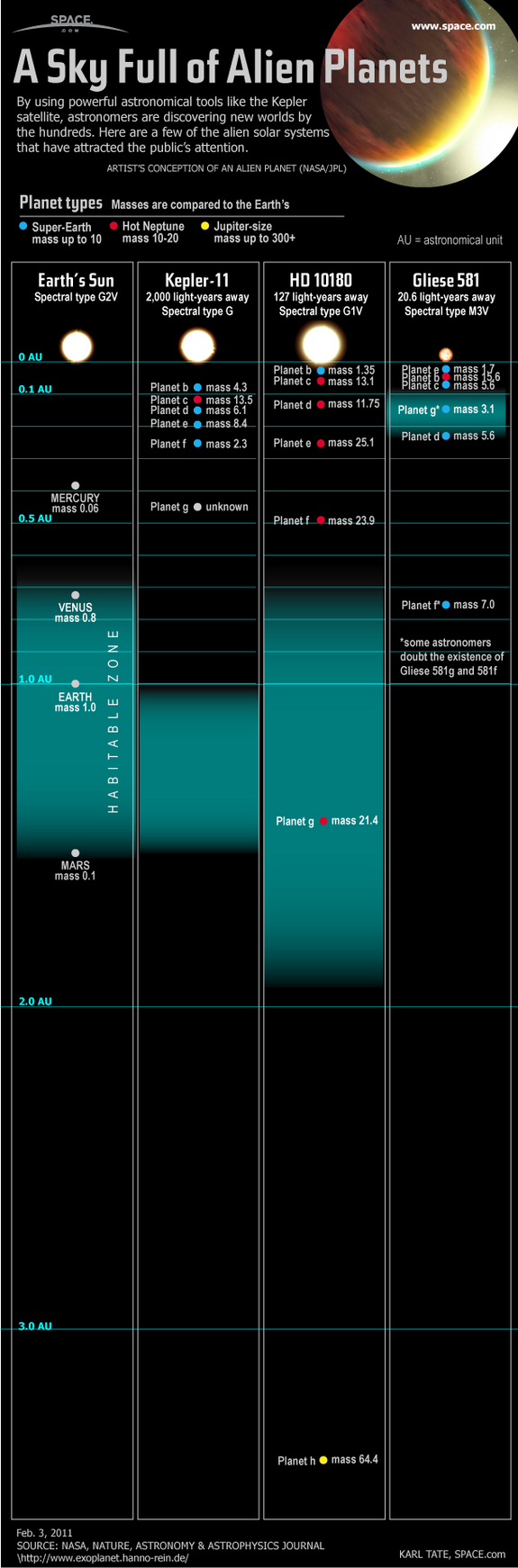
Source Space.com: All about our solar system, outer space and exploration -
The Esteli: an LM386N-based cigar box amp
The Esteli: Cigar Box instrument LM386N-based Amp from abram on Vimeo.
Here’s the latest in general purpose amplifiers made from reused parts. The enclosure is an old cigar box for which i have quite an affection as an enclosure. I really do love the sound of wood in both the recording process and amplifiers. In the video, you can really get an idea of how it treats the sound when i open the top.
As opposed to the LightBox, the Esteli has two knobs. The top is for volume and the bottom a 10k pot in the gain look between pins 1 and 8 on the IC. I’d probably recommend a 50k in this configuration, but it does make the amp really loud which i think is better for the instrument side of things. The gain of the amp then floats around 100-200 depending on where the gain is set. For more information, see the LM386 Datasheet.
-
fuzzy PT2399 on baritone guitar…

Here’s a loose guide that I’m using to migrate the PT2399 into stomp box world. Here’s a dry run sample with a Gretsch Baritone guitar.
[audio:http://abrammorphew.com/notes/wp-content/uploads/2011/06/pt2399_guitar_delay.mp3|titles=pt2399_guitar_delay] -
Square-wave Oscillator Meets PT2399…
Square-wave Oscillator with PT2399… from abram on Vimeo.
Very short video of the waveform captured using Xoscpe of the PT2399 applied to the LM386 square-wave oscillator. Sorry for the bad focusing. I was in a rush. I just needed a visual capture for later analysis.
[audio:http://abrammorphew.com/notes/wp-content/uploads/2011/06/osc_delay.mp3|titles=i just broke the gameboy]…and here’s a clip of the aforementioned wave from from around the same time.
-
LM386 Square-wave Oscillator

Here’s a small LM386-based square-wave oscillator built from the following schematic. I replaced the 30k resistor with a 50k Potentiometer from my stash of parts which then, of course, acts as a pitch controller. The following audio is some track recordings made in Ableton 8.0 with a little filter on one track and some reverb the air-raid siren sounding noise.


